Into the future of property development and management, with Limar Homes
In this interview we sit down with Manos Vasilakis , Co-Founder of Limar Homes . Limar Homes joined Breek.gr in December …


The era of ad-hoc and incidental property management services in Greece is coming to an end.
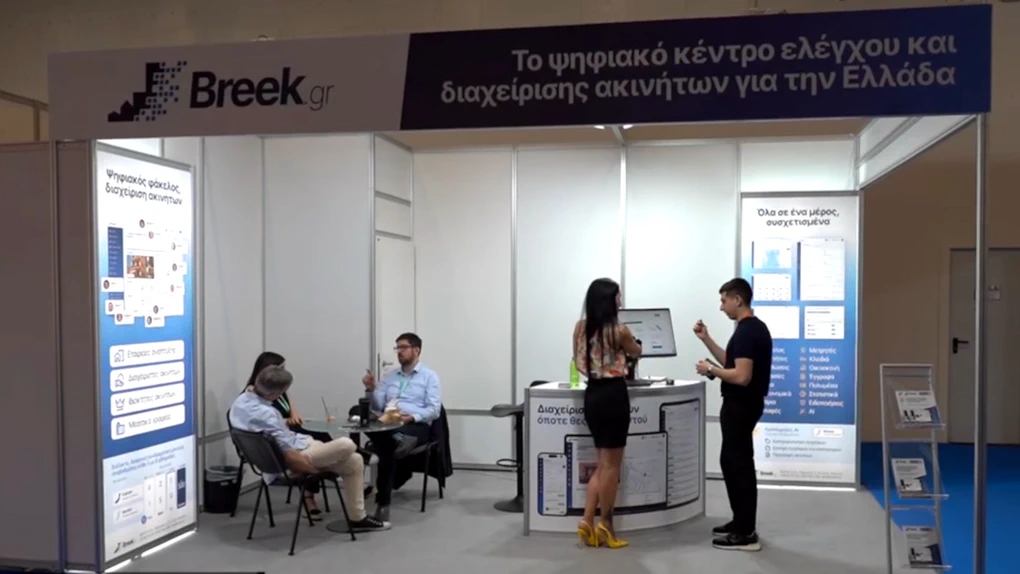
My recent participation in the Premium Real Estate Expo 2026 confirmed a clear trend: demand for professional Property Management in the Greek market is growing steadily. While participating and presenting at the Breek.gr as Entramos Property Management , I had the opportunity to speak at length with investors, institutional players, and property owners interested in professional asset oversight.
Yet beneath the enthusiasm surrounding the Greek real estate boom, a deeper concern emerged. There remains significant confusion about what Property Management actually entails, while a large part of the market continues to operate with methods that feel remarkably outdated given the volume and complexity of information a property manager handles daily.
Having spent 25 years at the heart of complex business environments (putting into use enterprise software systems ranging from commercial ERPs and CRMs to large-scale logistics platforms) I have developed a sharp sense for when a process is genuinely functional and when it is operationally compromised. The hard truth is that Property Management in Greece urgently needs clearer definition and digital discipline, before the term itself is devalued by misuse and misunderstanding.
The exhibition revealed a significant distortion: the term “Property Management” is frequently used as a vague marketing buzzword without a clear definition. Some companies and professionals (including lawyers and accountants) offer property management as a secondary or supplementary service, often handled incidentally to meet a client’s broader needs. Others manage short-term rentals and conflate that activity with full-spectrum property management. These are not the only sources of confusion, however. I encountered three primary misconceptions at the expo.
It is not brokerage. Brokerage is a transactional activity with a defined endpoint: identifying a tenant or buyer and executing the contract. Once the lease or sale is concluded, the broker’s role ends. Property management, by contrast, encompasses everything a property “experiences” throughout its life: tenancies, repairs, maintenance, and ideally even documentation from the construction phase onward.
It is not Facility Management or Hospitality services. Property management is often confused with day-to-day operational tasks such as cleaning, routine maintenance, or guest reception in short-term rentals. These are important but also purely executive functions. They represent subsets of activities along the property’s life-cycle rather than the strategic whole. True property management ideally spans the entire life-cycle of an asset.
It is not Real Estate Development. While property management includes documenting and overseeing information related to construction or renovation, it is not the same as development. Development focuses on creating or acquiring value. Property management focuses on preserving, optimising, and protecting that value over decades, which is particularly important for assets held as long-term investments.
It is not a low-complexity service that any professional can competently provide on the side. It simultaneously requires expertise in finance, operational management, legal and regulatory frameworks, tenant relations, and local compliance. More importantly, because of the sheer volume of information and the number of stakeholders involved in a growing property portfolio, it demands strong organisational discipline and continuous data management. Managing this complexity does not require exceptional qualifications, but it does require structured thinking, clear processes, and consistent execution. When property management is treated as a secondary activity or delivered by disorganised or unqualified providers, the outcome is almost inevitably substandard.
Property management belongs to the broader discipline of asset management when the asset in question is real estate. It constitutes an autonomous, specialised, and multi-layered form of asset oversight. It encompasses all activities required for the holistic, systematic, and strategic supervision of a property, with the objective of preserving its capital value, mitigating operational risks, and maximising net operating income for the owner or investor, thus effectively converting a theoretical income stream into reliable, passive returns on investment.
The ultimate goal is not merely smooth day-to-day operations, but the protection and enhancement of net operating income (NOI) and, by extension, the long-term value of the asset. Every decision, from preventive maintenance and tenant selection to timely rent collection, directly influences this metric and, therefore, the overall return on investment.
At the core of professional property management lies the reduction of information asymmetry between owner and asset. Owners (particularly those who do not reside in Greece) cannot know in real time what is happening with their property (unless they have joined Breek.gr…). A professional property manager acts as a trusted local representative with a duty of care and transparency. They do not merely execute tasks; they inform, advise, document, and protect the owner’s interests as if they were their own. This local fiduciary representation has become especially important in Greece in recent years.
The scope of responsibility is structured around four central pillars:
Financial management and reporting. Budget planning, cash-flow monitoring (both income and expenditure), active pursuit of timely rent collection, optimisation of operating costs, and delivery of detailed, periodic financial reports to the owner.
Preservation of asset value. Design and implementation of preventive maintenance programms to avoid structural deterioration, coordination of approved technical contractors, and rapid response to urgent repairs.
Tenant relationship management. Tenant screening and selection, lease finalisation (in coordination with brokers where necessary), day-to-day handling of requests, and maintenance of high satisfaction levels to reduce both physical and financial risk to the property and its owner.
Legal and regulatory compliance. Maintaining up-to-date knowledge (or at minimum close monitoring) of the institutional and tax framework, working with lawyers and notaries to draft robust lease agreements, and ensuring that both tenants and owners use the property in full compliance with applicable laws.
These four pillars do not operate in isolation. Their interaction is what ultimately protects the property from value erosion and creates sustainable, long-term value for the owner. Timely rent collection enables preventive maintenance; strong tenant relationships reduce wear and tear and the likelihood of legal disputes; and well-documented financial and operational history supports better strategic decisions. This interplay becomes manageable and measurable only when information is properly organised, accessible, and historically recorded.
The second, and more concerning, observation from the expo was the technological deficit, particularly when compared with management practices in most other industries. Listening to real-estate industry professionals, I realised that an overwhelming majority of companies still attempt to manage large portfolios on an ad-hoc basis: information scattered across notebooks and emails, messages on Viber, WhatsApp and WeChat, telephone calls, and data dispersed across Word documents and Excel files.
From my experience putting systems such as SAP and Entersoft through their paces in B2B commercial management, I understand the operational risks created by fragmented information. In property management, the absence of a centralised, digitised structure leads to several concrete problems:
In 2026, process digitisation should no longer be a differentiator but a baseline requirement for delivering high-quality property management services. And yet, most of the market continues to operate without it.
At Entramos , our objective from day one has been to deliver a level of service that genuinely meets the needs of owners and investors, and to do so in a way that supports scalable, efficient operations. This requires modern, specialised digital tools that centralise the history, documentation, required tasks, and outstanding issues for every property. Only then does the critical gap created by fragmented information close, and property management shift from being purely reactive to genuinely forward-looking.
The participants and visitors of the Premium Real Estate Expo 2026 sent a clear message: the Greek real estate market is maturing, and the expectations of owners (especially non-resident owners) are rising at a steady pace.
The future belongs to those service providers who treat property management as an autonomous, specialised service of high added value. This requires investment not only in technology, but also in clearly defined roles backed by genuine expertise and the right tools. When robust operations are combined with appropriate digital systems, property management ceases to be a necessary burden and becomes a genuine driver of value preservation and growth for the portfolio.
Owners and investors now have the ability to choose partners who meet both criteria. The era of ad-hoc and incidental property management in Greece is coming to an end.
Isidora Gkolemi
Entramos Property Management
Breek.gr Expert User
In this interview we sit down with Manos Vasilakis , Co-Founder of Limar Homes . Limar Homes joined Breek.gr in December …
In this interview we speak with Isidora Golemi, founder of Entramos . With 25 years of experience in ERP and CRM …
With your new user account on Breek.gr you can create and manage five properties for free, one of which with the full functionality of the Monitor tier. Test-drive Breek.gr now and experience first-hand how it makes property management a breeze!